


 |
Recollections of Gadda
William Weaver
Carlo Emilio Gadda is included in this volume, though I hardly knew him in the period I have written about. At that time he was approaching retirement age and had been given a position at the RAI (the Italian Radio, whatever its defects, supported a whole army of writers, including several of Italy’s best). I must sometimes have passed the tall, slightly bent, quiet and courtly gentleman, whose duties were vague, but whose presence at the office was scrupulous; but I didn’t recognise him at that time.
Gadda’s presence on the Roman literary scene was also profoundly felt, even if he was not often found at official receptions or smart parties. If Moravia was, through no fault of his own, Italian literature’s spokesman and official greeter; Gadda, also through no fault of his own, was Italian literature’s best-kept secret. It was not until 1957, when his great, forever-unfinished novel Quer pasticciaccio brutto de via Merulana appeared, that his name was known beyond a select circle of admirers, including many writers and artists.
That novel did nothing to diminish the aura of difficulty that surrounded his work; and I have to confess that, though I heard much about him, I had read nothing of his until, in 1963, John Ashbery wrote me from Paris, asking me to translate a Gadda story, The Fire in Via Keplero, for a new review, Art and Literature. I did, and in the process I came to know Gadda. At almost the same time, George Braziller asked me to take on That Awful Mess on Via Merulana (as it became in English), and – emboldened by my completion of the short story translation – I did.
For the next several years, I saw Gadda frequently, always in the company of his friend and future biographer, the critic and editor Gian Carlo Roscioni. Though I think Gadda liked me, we never became friends; and yet there were moments when I felt close to him, in what seemed his raw vulnerability and his narrowed life, confined by manias and codes all his own.
By the time I got to know him, he had retired from the RAI and was living alone in a tidy, anonymous apartment in a colourless, lower middle-class street, Via Blumenstihl, in a newly-developed quarter beyond Monte Mario. He had a daily woman, of uncertain but not young age, but she left before dark, because Gadda feared neighbours might gossip if she stayed on. He had a telephone but never answered it; for communication, the protocol was this: you telephoned his concierge, she gave him the message with his mail when he went out for his late-morning walk, and then he returned your call after the walk.
The first time I went to see him, shortly after I had signed the contract with Braziller, Gadda offered me a cup of tea. When I accepted, I saw a look of profound dismay come over his face. He excused himself, then I heard him in the kitchen conferring with the maid. She appeared and removed some books and papers from the table where we were sitting, a cloth was spread – but only over the part of the table directly in front of me – and, after a considerable pause, one cup filled with tea was set on the cloth, with a sugar bowl and a little jug of milk. I drank the tea, under Gadda’s scrutiny, with the feeling that I was taking some medicine. Neither Gadda nor Roscioni joined me.
Meanwhile the conversation proceeded, in a – to me – mysterious fashion. Gadda, with deferential circumlocution, apologised for the difficulty of his prose, as if its complexity were some terrible burden laid upon him. Afraid that he felt my grasp of his language might be inadequate, I made a special effort to speak my most erudite Italian, a pyrotecnical display of conditionals and past subjunctives and arcane vocabulary. But we seemed to be talking at cross-purposes, until finally, taking advantage of another visit of Gadda’s to the kitchen, Roscioni explained to me in a whisper that Gadda was afraid I was not being paid enough and, with extreme delicacy, he was trying to tell me that he would like to give me a contribution.
Exaggerating Braziller’s munificence – and with as much subtlety as I could muster – I gently rejected Gadda’s touching offer (I later learned that some of his other translators had accepted it, perhaps unaware of Gadda’s straitened situation). After that meeting at his house, we usually met at a restaurant, often the particularly pleasant, high-ceilinged Romagnolo, behind the Pantheon, now a fast-food place.
It was anything but fast in those days, and our dinners tended to be protracted events, for Gadda was discreetly greedy, and besides enjoying an abundant meal he particularly looked forward to the desserts. As a diabetic, I have long learned to live without cakes and pies, but (acting on Roscioni’s instructions) I always ordered some rich, creamy cake, then feigned a sudden loss of appetite, urging Gadda to eat it in my stead. I soon learned what his favorite sweets were and managed always to order the right ones for him.
Stories of Gadda’s eccentricities circulated in Rome like tales of Auden’s carpet slippers and his martinis in New York. But, when you were with him, even though comical episodes almost always occurred, you could not escape the sense of profound melancholy that seemed to accompany him. He spoke always as if from beyond some inner suffering, as an ill person will bravely speak of commonplaces on his hospital bed.
Published by The Edinburgh Journal of Gadda Studies (EJGS)
ISSN 1476-9859
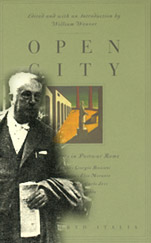
– previously published in W. Weaver (ed), Open City, Seven writers in Postwar Rome (South Royalton, Vermont: Steerforth Press, 1999), 33-35
Please note that the above excerpt is for on-line consultation only
Reproduced here by kind permission of William Weaver and Steerforth Press © 1999
© 2000-2026 by William Weaver & EJGS
artwork © 2000-2026 G. & F. Pedriali
framed image: cover of Open City, with photograph of Gadda superimposed
All EJGS hyperlinks are the responsibility of the Chair of the Board of Editors.
EJGS is a member of CELJ, The Council of Editors of Learned Journals. EJGS may not be printed, forwarded, or otherwise distributed for any reasons other than personal use.
Dynamically-generated word count for this file is 1028 words, the equivalent of 3 pages in print.