


 |
Biting the Gaddian Apple
a garden of linguistic delights…?
|
|
…or a hell of tormented paranoia?
|
|
If there is a unifying trait to Gadda’s output, it is its profound, constitutional disunity. It is a relatively vast body, all things considered. It is also deeply fluid. The main problem – for Gadda himself as for us – is how to group the various chunks together, how to structure the many short tales, the many projected, sketched-out, re-started, broken-up novels. Friends and editors cajoled, bossed and terrorised him into a semblance of coherence. Over the years, he took out of his chest his disparate narratives, mostly under duress. He arranged them in spuriously artificial collections (where, characteristically, the boundaries between fiction and essay writing are blurred in the extreme) and allowed their publication, usually to the accompaniment of much self-bemoaning.
Following his death, the remaining works were laboriously archived by loving scholars and slowly released into the public domain starting with the publication of Meditazione milanese (1974). The process reached a climax with the complete edition prepared by Dante Isella for Garzanti (1988-93), and it is still ongoing – the latest work to hit the shelves, Un fulmine sul 220, came out in 2000. Not even the elegant cofanetti of the Garzanti edition, however, can engender a feeling of compacted discipline: as readers facing the Gadda opus, we still share Emilio Cecchi’s feeling on first catching sight of Quer pasticciaccio in 1957: that of staring at a wall covered with graffiti.
What, then, of this Gaddian apple? Well, it may look different according to the angle it is looked at. It may taste different according to the time of day. One morsel is paradise, the next one may very well be hell. His is indeed the poisoned apple that changes colour with Galenus’s fabled humours, the classic pharmakon whose bottle one looks hard at before sharing its content with the pharmacist-author, not trusting the list of ingredients on the label (Hamlet? Raskolnikov? Don Quixote?) and checking the other customers in the shop with a quick side glance. Are they still alive? (Some look a bit glazed, some are busy trying all the reading positions suggested by Calvino in Se un notte d’inverno. Others, the more dangerous, read out constantly, recommending the containers on the shelves…).
Conceded that it poses formidable philological questions, Gadda’s work also has its advantages when it comes to fruition, though. Aspiring Proustians, for instance, have to face the discouraging reality of a seven-volume battle to reach the end of his imposing oeuvre. Gadda newbies can instead look forward to bit-sized mouthfuls to get settled into things. One does not need systematic approaches to enter the Gadda realm. His work is fractal-like, any portion will reveal the structure of the whole. And then, there is no whole, is there?
Also, taken up in small doses Gadda will slowly, by the miracles of mithridatism, be absorbed into the reader’s consciousness, until terminal addiction may set in. A good, classic start can be the deceptively brief Ortolano di Rapallo. Proceeding along vaguely culinary lines, one could then dip into a recipe for Risotto patrio. Once seated at the Gadda table, it could perhaps be in order to have a look around the house too, for instance in La nostra casa. With a brisk change of gear, one could take the plunge into Gadda epos, and explore a house of a different kind, in one of the most celebrated passages from his works, Vagava, sola, nella casa. Intrigued by the darkness in there, the reader may then wish to unravel its origins. In these psychoanalyticised days, a visit to the couch seems inevitable. Two doctors are on offer: an imagined Freudian Ersatz (Una tigre nel parco) and an old fashioned family physician (La visita medica) – take you pick according to inclination. Perhaps by now you need a break, and why not go to the pictures for a change (Cinema). Perhaps you want to know more about Gadda, the texts are fascinating, but some background would be helpful. Fear not, for the Companion to Gadda will offer just that.
Once completed, the 33 walks should provide a graded entry into the Gadda world. At present they are mostly place-holders for things to come. Please be patient. Eventually they will all be filled with wise words. For now, there are quotations from some of his best known works, and quite a few of the further reading cards have useful links to the rest of the site. A quick browse through the walks may already give some visual pointers. For more substantial clues, you could start with some of the lectures, the Dombroski piece on Gadda, Svevo and Pirandello, for example.
The English Section has a substantial selection of primary and secondary works, and if English is your only option, then go there by all means. Italian-endowed readers will find in the two Manzotti articles all the information needed to place Gadda firmly in context. It is impossible and unnecessary to indicate any further progress through the site. Once you have tasted the apple, you’ll be on your own. Links are provided just about anywhere, and will grow over time. It will be your decision, then, how the site works for you, what pathways you draw across the things on offer. Gadda for one would perhaps feel relieved that his work is no longer in need of cofanetti to pin it down within harsh confines. Happy browsing.
La mia scuola letteraria, poi, va dallo Stelvio al Capo di Spartivento, per quanto concerne la plurità del dire: e così alcuna volta parrò malgrazioso, e allobrogo o retico: per altri criteri va dal Carso, dove ho sudato, alla landa hannoverese e alla fortezza di Federico di Rastatt, dove non disdegnai le crude bucce delle patate: e dall’Adamello e dai selvosi Altipiani ad altri siti ancora.
E poi nelle mie vene di bastardo è sangue ungaro e celtico, e visigotico e longobardico. E poi una congerie di modelli e una moltitudine di maestri: e verso questi una mia «diligentia» cioè quasi un amore. E una «disciplina», cioè quasi una guerra.
(Meditazione milanese, SVP 890)
 |
Published by The Edinburgh Journal of Gadda Studies (EJGS)
ISSN 1476-9859
© 2000-2026 by Federica G. Pedriali & EJGS
artwork © 2000-2026 by G. & F. Pedriali
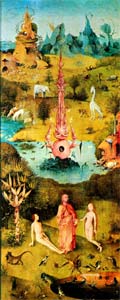
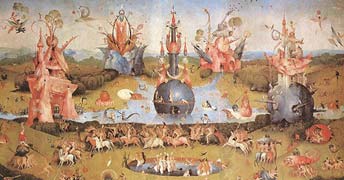
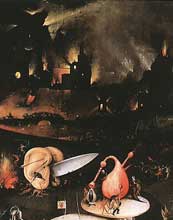
background and framed images: Hieronymus Bosch, The Garden of Delights, c. 1500, Museo del Prado, Madrid
All EJGS hyperlinks are the responsibility of the Chair of the Board of Editors.
EJGS is a member of CELJ, The Council of Editors of Learned Journals. EJGS may not be printed, forwarded, or otherwise distributed for any reasons other than personal use.
Dynamically-generated word count for this file is 1177 words, the equivalent of 4 pages in print.